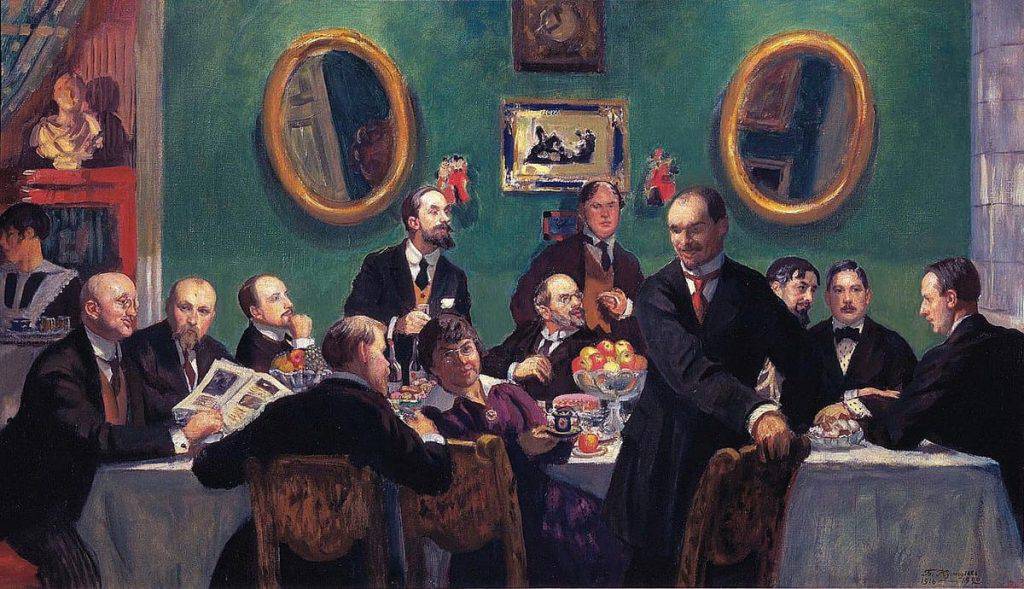


When “Gone with the Wind” was released in all the countries of the world, it was a story in which the orders and values of former times became a matter of the past. Russian art has its own so-called “gone with the wind” people. They lived at the turn of the 19th and 20th centuries, believed in aesthetics, freedom of art, and worshiped beauty.
Anastasia Postrigay, art critic and founder of the OP-POP-ART School of Popular Art, tells Mover about the “World of Art” association, which united the brightest stars of the turn of the century.
The “World of Art” is an outstanding creative association. Among the members were people of different talents, so the art that they created was truly amazing. This was an unusual mixture of classic, slightly old-fashioned beauty and aesthetics including boldness, innovation, the rebellion of the coming 20th century.
They didn’t like both academicism and the acutely social art of the Itinerants. Members of “World of Art” stated: ”We’re definitely not preachers of lies, but we‘re not slaves of truth either… First of all, we’re a generation craving for beauty.“
Their history began with the “Pickwick Club” of St. Petersburg. In 1887, in the private school of Karl May, a “Nevsky Pikvikians” association was founded. Among the members were several famous art figures: Alexander Benois, Walter Nouvel, Dmitry Filosofov, and Konstantin Somov. Sergey Diaghilev and Leon Bakst joined “Nevsky Pikvikians” later. Of course, now all these people are well-known artists but then they were only seventeen or eighteen years old.
At first, the association was a hobby club. Members just had fun and studied art together. However, Diaghilev’s vigorous energy gradually turned the regular club into a reputable “World of Art” association. The group was joined by Korovin, Serov, the Vasnetsov brothers, Vrubel, Nesterov, and many others.
Of course, “World of Art” quickly became popular. The amount of creative energy and ideas generated per square meter of the club was just insane. Besides, Diaghilev, who was the most talented producer of the 20th century, was a member of the club. As a result, by 1899 the “World of Art” had become a large association, which organized exhibitions of works not only of Russian artists but also of Monet, Whistler, and Degas.
The paintings were selected according to the tastes and preferences of the club’s members. They primarily focused on the personality and inner world of the artists: “A work of art is important only if it’s an expression of the artist’s personality.”
The 20th century, full of revolutionary ideas, wasn’t the best environment for people who wanted to live in an atmosphere of beauty and aesthetics.
Here’s the story. In March 1905, Diaghilev opened an exhibition of Russian portraits: he presented a huge collection in the Tauride Palace. He traveled around the country, persuading the aristocrats to give him the portraits of their ancestors which were only collecting dust in the empty corridors of their houses. Diaghilev wanted portraits to be demonstrated to people. During the first revolutionary wave in the summer of 1905, which caused major destructions, it was Diaghilev’s exhibition that saved these portraits. Many other masterpieces of art and heirlooms were destroyed during clashes.
The “World of Art” members were escaping from such a reality by looking more and more into the past. Of course, they didn’t completely deny the avant-garde that was emerging in front of them, however, they found comfort in something more refined and exquisite.
Romanticism, symbolism, Pre-Raphaelites, and Art Nouveau – these were representations of beauty, aesthetics, and freedom of creativity. The world was crumbling and breaking into pieces, however, just like the Titanic orchestra, the “World of Art” members continued to play their own “music”.
The “World of Art” did not last long, it was just a couple of decades. However, this association managed to give a lot to world art.
It was the artists of the “World of Art” that took an active interest in theater, ballet, and printing.
It was they who brought book illustrations to a new level, turning them almost into masterpieces.
It was they who created such amazing sets and costumes that after the Russian Seasons tour, French fashion houses could barely cope with many orders for clothing tailoring.
They create several trends that still exist: from incredible clothes on the catwalks to the brightest shows and concerts.
Everything ended in the 1920s. First, Diaghilev became too busy with Russian Seasons. Then Benois and the others left the association. Soon after the 1917 revolution, the “World of Art” finally stopped existing.
The epilogue of this story was written by the “World of Art” members themselves: “We loved the world and the beauty of things too much. Then there was no need to deliberately distort reality… we were naive and pure, and maybe this was the dignity of our art.”
There was no place for them in the new Soviet world. However their ideas, discoveries, survived works – all this became a powerful impetus for the next generations of creators.